

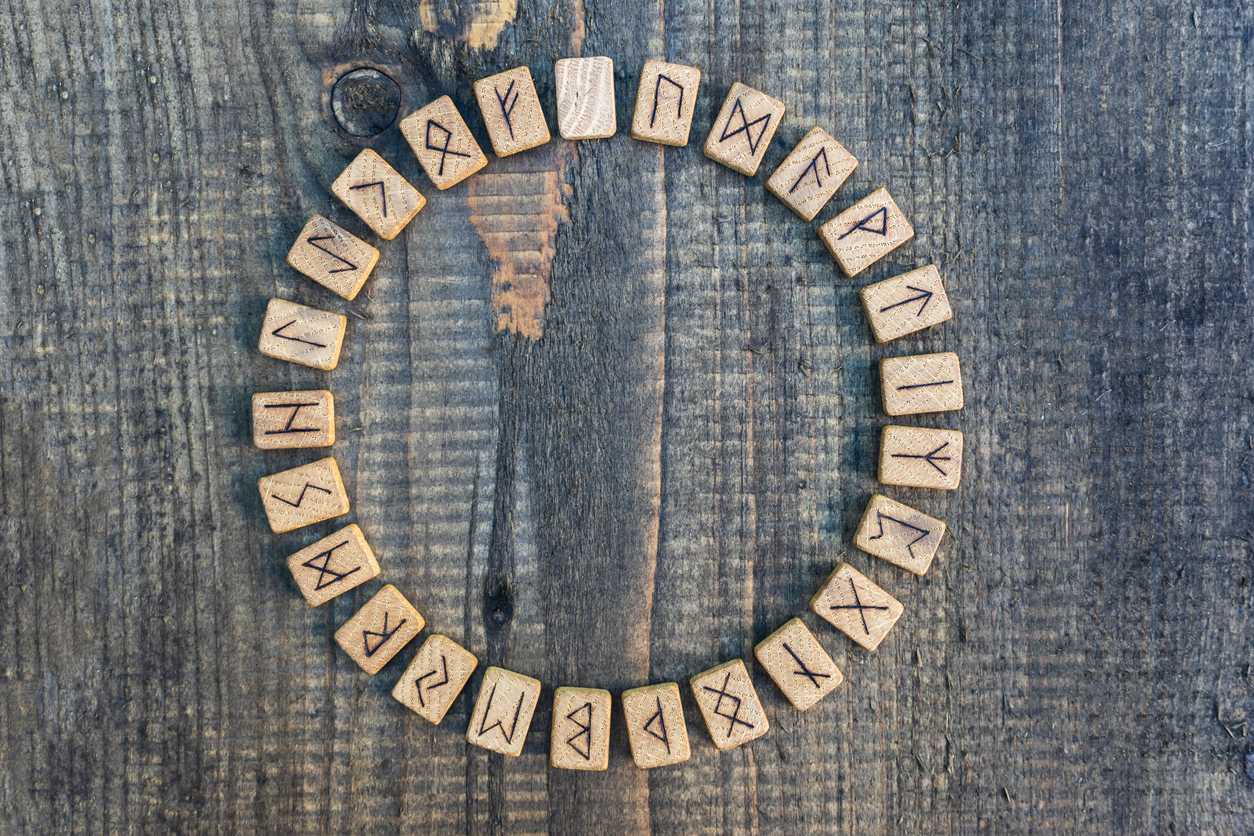
Runes have a real history as writing, and a separate life in contemporary spiritual practice. Keeping those subjects distinct helps you learn about the past without treating a modern reading as a guaranteed message about your future.
This guide offers a short historical starting point and an optional reflection exercise. It does not claim that rune casting can diagnose illness, guarantee protection or determine your destiny.
Runes were letters, not simply spell symbols
The National Museum of Denmark describes runes as a Germanic writing system that developed with influence from Mediterranean alphabets. Its inscription database provides access to hundreds of examples.
That history is different from saying that people in Germany used runes “for writing in Latin,” or that their only purpose was spell work. A script is a system for representing language; the existence of a symbol does not tell us that every use of it was magical.
There is more than one runic alphabet
The Swedish National Heritage Board’s introduction to reading runes explains the change from an older 24-character row to a later 16-character row. These are commonly called the Elder and Younger Futhark respectively.
So “24 Norse runes” is not a complete description of all runic writing. When studying a chart, ask which alphabet, language and period it represents. A modern product’s inclusion of an extra blank tile should not be taken as evidence that it belongs to the historical alphabet.
What about magic and mythology?
The National Museum of Denmark’s discussion of runic magic describes magical uses in saga accounts while noting that most surviving inscriptions contain more everyday messages.
A historical account of a belief is not proof that the claimed power works. You can study a story, object or religious tradition in its own context without turning it into an instruction to seek healing or protection from a rune today.
Which kind of claim are you looking at?
Historical writing
Ask: Which alphabet, language and period?
Check: An inscription record, museum reference or scholarly explanation.
Myth or belief
Ask: Which named text or account describes it?
Remember: Recording a belief does not establish that its claimed power works.
Modern interpretation
Ask: Whose guidebook or method assigns this meaning?
Label: A contemporary reading, not automatically an unchanged ancient practice.
Personal reflection
Ask: What association am I making?
Return to: Facts, choices and an action that makes sense without the symbol.
Modern readings are interpretations
A contemporary reader may draw or cast marked pieces and use a guidebook or personal associations to discuss a question. Ask which system they follow and how they distinguish a traditional source from their own interpretation.
Do not assume that a “birth rune” chart establishes a fixed life path, or that every modern technique is an unchanged Viking practice. If someone makes a historical claim, ask for a source you can examine.
An optional one-symbol reflection
The following is an original reflective exercise, not a reconstructed ancient ritual or a test of psychic accuracy:
- Choose a manageable topic. For example: “What should I consider before taking on another project?”
- Use one symbol. Draw a tile if you already own a set, or choose a symbol from a clearly identified reference.
- Name the association. Write “This makes me think about…” rather than “This predicts…”
- Return to facts. Consider your actual time, commitments and available help.
- Choose a modest action. You might check a deadline or ask a question before deciding.
You may find the association unhelpful. There is no requirement to keep drawing until a message seems to fit, or to treat a random selection as an instruction.
Keep important decisions outside the casting bag
A rune cannot establish whether someone is faithful, whether a treatment will work or whether a financial offer is sound. For consequential choices, use relevant information and qualified advice where appropriate.
If a reading frightens you, pause. A symbol is not evidence that you are cursed. Be cautious of anyone who turns a worrying interpretation into pressure to buy additional readings, protective objects or urgent rituals.
Materials do not need to be elaborate
You can learn about runic writing without buying anything. Museum resources are a useful starting point, and paper symbols are enough for a personal journalling exercise.
If using small tiles, keep them away from children or pets who might swallow them. Do not bury objects in shared or protected places or carve symbols into monuments, trees or property you do not own.
Respect the difference between learning and claiming authority
Be clear whether you are discussing archaeology, a named text, a contemporary belief or your own creative interpretation. These can all be interesting, but they do not answer the same questions.
A thoughtful rune practice can remain optional: a way to consider a question, not a source of certainty that overrides your judgement.
Read next
- Compare divination tools and the difference between symbolic prompts and factual claims.
- Explore card reading for another example of separating history, assigned meanings and original exercises.
- Review ethical reading boundaries before offering interpretations to someone else.
15 frequently asked questions
1. What are runes?
Runes are characters in historical Germanic writing systems. Modern spiritual readers also use marked pieces for interpretation, but that practice should be distinguished from reading historical inscriptions.
2. Were runes used only for magic?
No. Historical inscriptions include everyday writing and memorial messages. Evidence that some people associated runes with magic does not make every inscription a spell.
3. What is the difference between Elder and Younger Futhark?
They are different runic alphabets. The older row has 24 characters, while the later Younger Futhark has 16; identify the alphabet before using a chart.
4. Does every rune set represent the same alphabet?
Do not assume so. Check the product or reference description, the characters included and the stated system. A modern reading set is not automatically a complete guide to historical writing.
5. Is a blank tile a historical rune letter?
An extra blank tile in a contemporary set should not be treated as evidence of a historical letter. If a guide assigns it a meaning, identify that as part of the guide’s chosen method.
6. Is rune casting the same as translating an inscription?
No. Translating an inscription involves identifying characters, language and historical context. A contemporary reading assigns interpretations to selected or cast symbols.
7. How can I check a claim about ancient rune meanings?
Ask for the named text, inscription, museum record or scholarly reference behind the claim. Separate what the source actually records from the modern author’s interpretation.
8. Do I need to buy a set to start learning?
No. Museum introductions and inscription resources can support historical study. Paper symbols are sufficient for the optional journaling exercise described here.
9. Are stone runes better than wooden ones?
Material and price do not establish predictive power. If you want a physical set, prioritize legible markings, ordinary durability, safe handling and your budget.
10. What is a suitable beginner reflection question?
Choose a manageable topic about your own actions, such as what to consider before taking on a project. Avoid treating the symbol as an answer about health, money or another person’s private thoughts.
11. How does the one-symbol exercise work?
Choose a symbol from an identified reference, note an association, then return to facts about your situation. Pick an action only if it makes sense independently of the symbol.
12. What if the symbol does not seem relevant?
It is fine to record that nothing useful came from it and stop. Drawing repeatedly until something fits does not verify a message or prediction.
13. Does a birth rune determine my personality or destiny?
A modern birth-rune chart does not establish a fixed identity or life path. Treat it as an interpretive system, not a requirement to make choices that match its description.
14. Can a rune prove that I am cursed or in danger?
No. A threatening interpretation is not evidence that you are cursed. Pause the reading and do not let fear pressure you into buying protection, urgent rituals or repeated sessions.
15. How can I use or study runes respectfully?
Name the alphabet and source, distinguish history from personal interpretation, and avoid claiming authority you do not have. Do not carve into monuments, trees or property you do not own; keep small tiles away from children and pets.
What a fascinating article! I have always been intrigued by ancient traditions and practices, especially those that have managed to endure through centuries. The Norse runes, with their rich history and deep connection to mythology and spirituality, offer a unique glimpse into the past. The concept of birth runes and their ability to influence one’s path based on destiny and personal choices is particularly compelling. It is remarkable how these symbols have been integrated into various aspects of life, from rituals to divination. This piece has certainly deepened my appreciation for the mystical and historical significance of runes.
I thoroughly enjoyed this insightful exploration of runes and their significance in Norse culture! The detailed explanation of the origins and uses of runes, as well as their magical properties, was both enlightening and captivating. It’s fascinating to see how the ancient Norse people utilized these symbols for both practical and spiritual purposes. The comparison to tarot cards was particularly interesting, as it highlights the adaptability and multifaceted nature of runes in divination practices. As a student of ancient cultures, I find the idea of creating personalized runes and seeking guidance from them to be a beautiful continuation of a timeless tradition. Truly an inspiring read!
The historical origin and application of runes is quite fascinating. It’s intriguing to see how a system of writing has evolved into a tool for divination and personal insight.
The idea that destiny can be influenced by personal choices reflects the dynamic nature of runes in divination. It emphasizes the balance between fate and free will.
The comparison of runes to tarot cards is interesting. Despite their differences, both systems seem to offer a similar type of personal guidance and reflection.
The mention of making one’s own runes with various materials adds a personal touch to the practice. It appears to be a deeply individualized and intuitive process.
The detailed list of the 24 Norse runes provides a good starting point for anyone interested in this tradition. It’s crucial to understand the cultural and historical context behind these symbols.