


Compare the commitment—not the promise
Start with the actual syllabus, prerequisites, format and full cost. Verify what a certificate means and keep employment expectations separate from a provider’s spiritual claims.
Psychic training is not one standardized qualification. A workshop, a spiritual-development program, an academic degree and a professional license are different things. Compare what a course actually teaches before deciding whether it suits your interests.
This guide provides three examples with identifiable official information, followed by a practical comparison checklist. It is not a “best schools” ranking, an accreditation assessment or a promise that a course develops supernatural abilities.
Confirm current dates, prices, format and terms directly before booking.
Three starting points for your own research
Lily Dale Assembly: workshops in a Spiritualist community
Lily Dale Assembly’s official website describes a Spiritualist community in western New York and lists lectures, workshops and seasonal events. This is a setting for exploring a spiritual tradition, not a single uniform professional-training course.
Check before booking: the individual event description, presenter, intended level, accessibility, admission arrangements and any separate travel or lodging costs. Do not assume that attending a workshop provides a credential or eligibility for a paid role.
Boulder Psychic Institute: a sequenced course pathway
Boulder Psychic Institute’s course page presents introductory courses and longer programs, with prerequisites and a stated sequence. Its descriptions use spiritual concepts such as healing, energy awareness and clairvoyant development; these are the provider’s framing, not outcomes independently verified here.
Check before enrolling: which prerequisite you need, the full commitment beyond an introductory class, live-practice requirements, feedback arrangements and the cost of each stage. Do not interpret “graduate” terminology as proof of an academic degree.
Clairvoyant Center of Hawaii: a multi-stage remote program
The Clairvoyant Center of Hawaii’s curriculum overview describes two 12-week stages followed by a 21-month stage. Its homepage describes phone delivery, while its events page lists Zoom or audio teleconference. Confirm the delivery method for the particular course or event; do not assume every offering uses the same format.
Check before enrolling: the exact delivery method, time zone, attendance expectations, practice commitments and complete cost. Ask whether business-skills teaching is included; do not assume spiritual training also prepares you to run a paid practice.
Compare the course, not just the school name
Two classes from the same provider can differ substantially. Request a syllabus for the specific course and compare:
- Purpose: personal reflection, religious study, performance, a provider’s reading method or a clearly defined professional skill.
- Format: live instruction, recordings, telephone sessions, in-person meetings or a mixture.
- Feedback: who reviews your work and what criteria they use.
- Time: teaching hours plus homework, practice, travel and required events.
- Access: captions, transcripts, mobility needs, scheduling and whether an activity can be declined.
- Privacy: recording rules, handling of practice partners’ information and permission to share examples.
- Exit terms: cancellation, refunds, missed sessions and ongoing payment obligations.
These are comparison questions, not claims that every listed provider offers each feature.
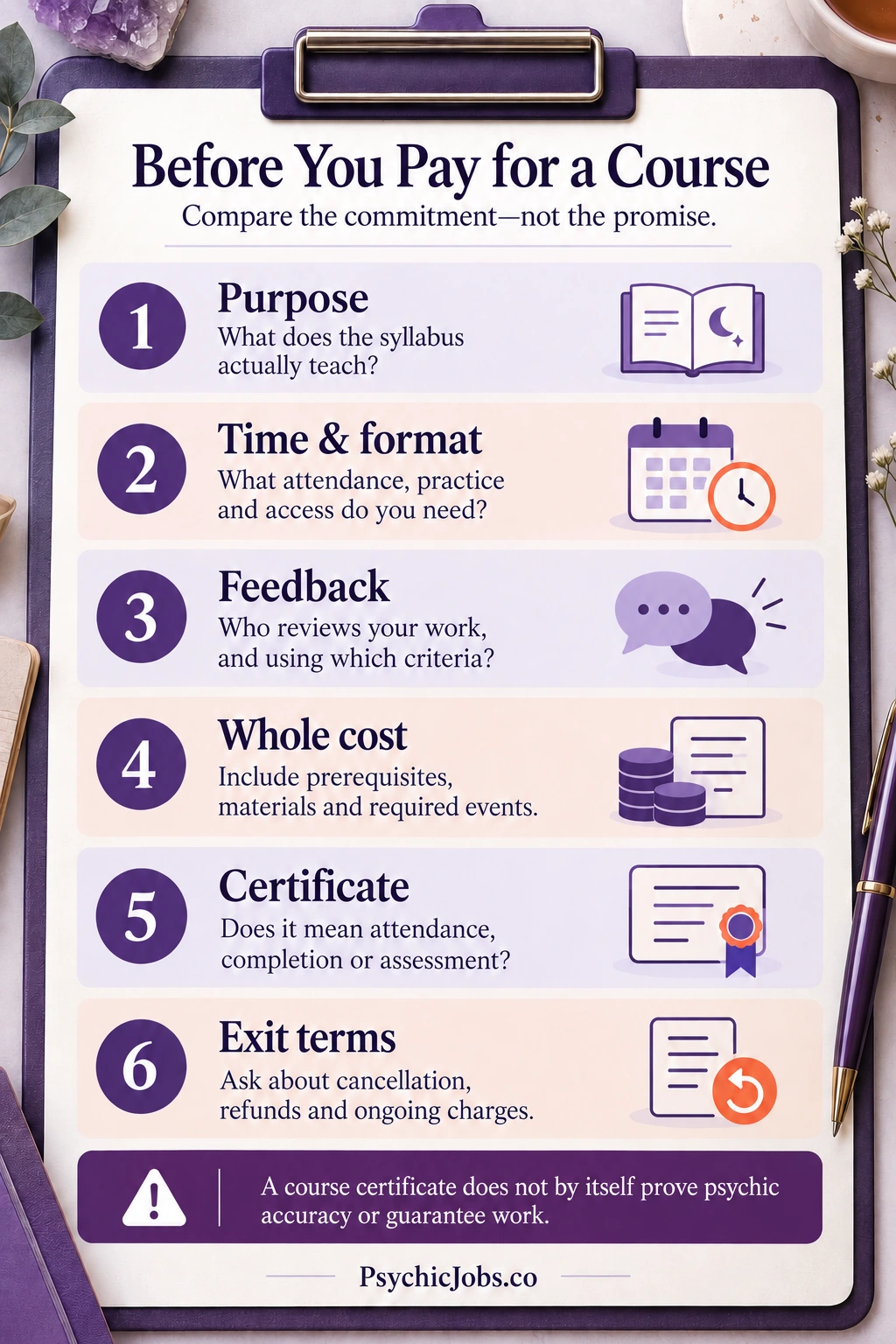
Read the infographic text
Compare the commitment—not the promise.
- Purpose: What does the syllabus actually teach?
- Time & format: What attendance, practice and access do you need?
- Feedback: Who reviews your work, and using which criteria?
- Whole cost: Include prerequisites, materials and required events.
- Certificate: Does it mean attendance, completion or assessment?
- Exit terms: Ask about cancellation, refunds and ongoing charges.
A course certificate does not by itself prove psychic accuracy or guarantee work.
Ask what a certificate actually means
A certificate may record attendance, completion or a school’s own assessment. Ask which one applies. It does not, by itself, demonstrate psychic accuracy, clinical competence or acceptance by an employer.
If a provider uses words such as “university,” “accredited” or “graduate,” verify the exact institution, awarding body and credential. Academic programs should be assessed on their actual academic purpose, not presented as interchangeable with psychic-development workshops.
For a role with formal licensing requirements, check the relevant regulator. Do not use a spiritual-course certificate to imply qualifications you do not hold.
Calculate the whole commitment
Ask for a written total that includes required prerequisites, materials, assessments, recurring charges and compulsory events. For residential study, add transport, accommodation and time away from work.
Compare that total with what you can afford for education or personal interest without assuming future reading income will repay it. A low introductory price may not represent the cost of the complete pathway.
A useful inquiry is: “What would I need to pay and attend to reach the outcome described on this page, and what happens if I stop after the first stage?”
Keep professional preparation separate
If your aim is paid work, you also need to understand the actual role: client consent, accurate advertising, privacy, complaints, fees and appropriate limits. A spiritual curriculum may not cover those subjects.
Read our guide to classes, consent and limits and work-from-home planning guide only where relevant to your goals. Confirm application requirements with the employer or platform itself; no school listing here guarantees acceptance or income.
Before offering sessions, review ethical boundaries for online readers. If a provider treats doubt as a problem to sell away, see how to question paid unblocking claims.
18 frequently asked questions
1. Is psychic training a standardized qualification?
No single meaning is established by that phrase. A workshop, a school’s completion certificate, an academic degree and a professional license serve different purposes and should not be treated as interchangeable.
2. What should I confirm before booking a course?
Confirm the current dates, price, format, teaching scope and cancellation terms with the provider. Ask how feedback is given and what any certificate actually means.
3. Are the three providers ranked from best to worst?
No. They are starting points for research, not a ranking or endorsement. Compare the specific offering against your own purpose, budget and access needs.
4. What should I check about a Lily Dale workshop?
Review the individual event, presenter, intended level, access arrangements and admission requirements. Add any travel and lodging costs; attendance alone should not be assumed to provide a credential.
5. Why do prerequisites matter at Boulder Psychic Institute?
Its course page describes a sequence with required prerequisites. Ask which stage you need and the full time and cost commitment, rather than treating an introductory price as the whole pathway.
6. How long is the Hawaii provider’s stated pathway?
Its curriculum overview lists two 12-week stages followed by a 21-month stage. Confirm current scheduling, breaks and attendance requirements directly before treating that outline as your personal completion timetable.
7. Are the Hawaii courses by phone or Zoom?
The homepage describes phone delivery, while the events page lists Zoom or audio teleconference. Confirm the exact format for your chosen course or event, including connection requirements and time zone.
8. What should I request before enrolling?
Ask for the specific syllabus, prerequisites, schedule, feedback process, full costs and written cancellation terms. Clarify which activities and practice sessions are required rather than optional.
9. What does a completion certificate prove?
Ask whether it records attendance, completed assignments or the school’s own assessment. It does not by itself demonstrate psychic accuracy, clinical competence or recognition by an employer.
10. Does the word graduate mean an academic degree?
Not necessarily. Verify the awarding organization and exact credential. A provider’s terminology should not be substituted for evidence of academic status or professional recognition.
11. What costs belong in the comparison?
Include prerequisites, tuition, required materials, assessments, compulsory events and recurring charges. Add travel, accommodation and time away from other work where relevant.
12. Should I assume future reading income will pay for training?
No. A course listing does not guarantee work or income. Assess whether you can afford the commitment for its actual educational or personal purpose without relying on an uncertain return.
13. Is the longest course automatically the best?
No. Duration does not establish quality or fit. Compare the syllabus, feedback, access, total commitment and exit terms rather than using length as a quality score.
14. What accessibility questions should I ask?
Ask about captions or transcripts, mobility access where relevant, scheduling, technology requirements and options to decline activities. These are questions to confirm, not features this guide assumes every provider offers.
15. How should practice-session privacy be handled?
Clarify recording, storage and sharing rules before participating. Ask how practice partners give consent and whether personal examples may be used in teaching or marketing.
16. Can completing a course guarantee a reading job?
No. Check a prospective employer’s or platform’s current requirements directly. A school’s certificate may not be required or accepted, and no listing here guarantees hiring.
17. Does a spiritual curriculum include business preparation?
Do not assume it does. Ask whether it covers consent, advertising, privacy, complaints, fees and service limits, or whether those subjects require separate preparation.
18. When should I slow down or decline enrollment?
Pause when faced with rushed decisions, guaranteed powers, hidden costs or escalating payments for protection. You can ask questions, start with a limited activity or decide not to enroll.
The Boulder Psychic Institute and the Atlantic University appear to take a multifaceted approach to psychic education, including both undergraduate and graduate programs. This seems to support serious academic inquiry alongside practical skills development.
This article is a fascinating guide for anyone interested in developing their psychic abilities. The range of institutions you listed, from the historic Arthur Findlay College in the UK to the modern and flexible online platform of Udema, provides diverse options for various learning styles and needs. It’s encouraging to see such comprehensive programs that include everything from spiritual philosophy to practical applications like dream interpretation and animal communication. Thank you for this well-researched and informative piece!
What an enlightening article! The detailed descriptions of these schools really highlight the depth and breadth of training available for aspiring psychics. I’m particularly intrigued by the Boulder Psychic Institute and its structured programs in trance mediumship and telepathic communication. It’s wonderful to see that there are even programs that cater to various aspects of psychic development, such as the holistic approach at Atlantic University. This is truly a valuable resource for anyone on their psychic journey!
The existence of institutions like Lily Dale and Arthur Findlay College indicates a long-standing tradition in the study of spirituality and psychic phenomena. It would be interesting to learn about the methodologies employed in their teachings.
The range of options presented in the article is quite diverse. Each institute seems to bring its own unique approach to psychic development. It might be worthwhile to research these schools further to understand their philosophies and methodologies.
These schools appear to offer comprehensive programs that cater to various aspects of psychic abilities. From traditional spiritual philosophies at Arthur Findlay College to the more dynamic courses at Mystic University, there’s something for everyone interested in this field.
It’s interesting to see how structured and academic some of these programs are. The inclusion of subjects such as psychology and leadership at Atlantic University is particularly noteworthy. It suggests a holistic approach to psychic development.
The range of courses and specializations offered at these schools implies a serious commitment to the practice of psychic arts. It is surprising to see such organized academic structures dedicated to this field.
The diversity of courses available on platforms like Udema and at schools like Portland Psychic School highlights the increasing accessibility and formalization of psychic education. The focus on meditation and mindfulness is particularly noteworthy for their relevance in contemporary psychological practices.
The incorporation of modern technologies and platforms, like Udema’s extensive video courses, provides convenient access to learning resources. This could be particularly beneficial for those unable to attend physical classes.
It is intriguing to note the variety of institutions dedicated to the cultivation of psychic abilities. The inclusion of traditional educational elements and holistic development aspects suggests a comprehensive approach to psychic training.
The emphasis on both practice and theory across these institutions is commendable. Practical experience, such as the readings required at the Clairvoyant Center in Hawaii, seems essential for genuine skill development.