

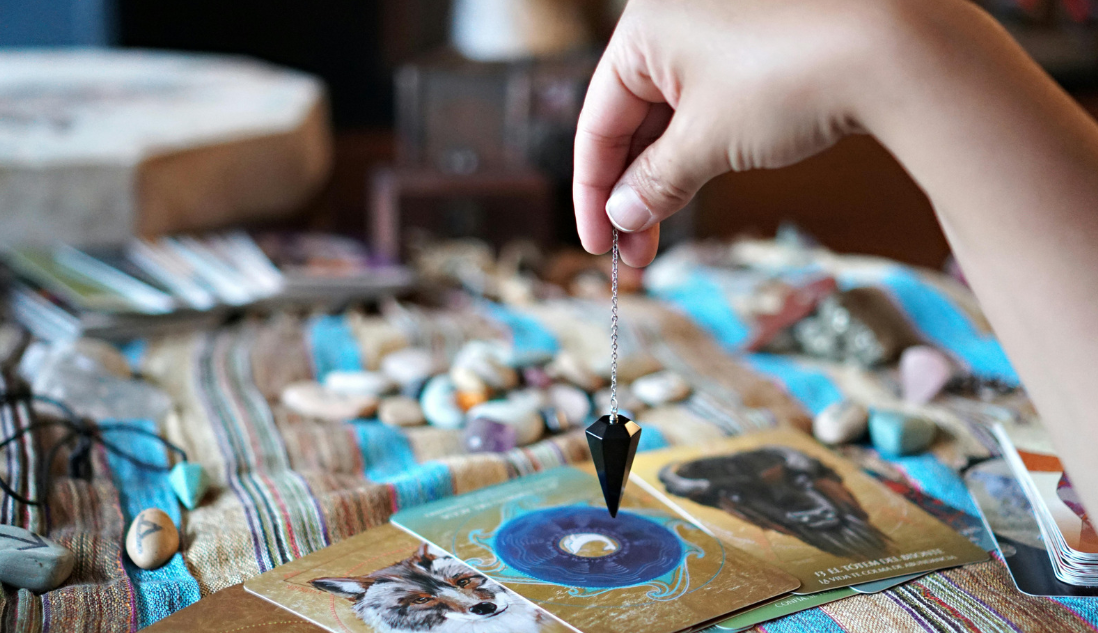
Divination tools give a reading a format; they do not make its claims automatically true. Cards, symbols and objects can provide prompts for interpretation or personal reflection. Some practitioners understand them spiritually. That belief should be explained as a belief, not presented as verified access to the future or another person’s mind.
Before choosing a reader, ask what they use, what information they need and what the service does—and does not—promise.
Choose the format—not a promised future
A visual comparison of common reading formats and questions worth asking.
Images → interpretation
Tools: tarot and oracle cards.
Ask: Which deck and method?
Limit: a symbol is not proof of an event.
Movement → assigned meaning
Tools: pendulums and talking boards.
Ask: How is movement interpreted?
Limit: motion does not verify a message.
Chart → interpretation
Tool: an astrology chart.
Ask: What birth details are needed?
Limit: precise data does not prove a prediction.
Text or symbol → reflection
Practices: runes and I Ching, each with its own context.
Ask: Which source or tradition?
Limit: history does not validate modern foresight.
Surface → impression
Tools: crystal balls and other scrying surfaces.
Ask: What was observed versus inferred?
Limit: imagery is not a future recording.
Pattern → interpretation
Practices: palmistry and tea-leaf reading.
Ask: Is touch, a photo or a drink required?
Limit: no diagnosis or lifespan prediction.
For every format: consent + clear costs + privacy + room to disagree.
Cards: tarot and oracle decks
Readers interpret images, positions and combinations of cards. Decks and reading styles vary, so ask which system is being used rather than assuming every symbol has one fixed meaning. The V&A’s history of tarot distinguishes the cards’ history as games from their later use for divination.
A useful reflection question might be, “What options have I not considered?” That is different from treating a card as proof that an event will happen. A reader should explain an interpretation without insisting that disagreement means you are resisting the truth.
Explore card reading and its history or how readers approach tarot reversals for more detail.
Pendulums and talking boards
A pendulum moves while suspended; a talking board uses a movable pointer over letters or other markings. Some users assign meanings to the movements. The movement alone does not establish where a message comes from or whether it is accurate. The APA describes ideomotor activity as movement linked to thoughts but not consciously intended. This is one reason not to infer a supernatural source merely from motion.
Avoid treating a yes-or-no result as permission for a consequential decision. Do not let a group pressure you to participate, and do not use a board result to accuse someone or claim certainty about a deceased person. For sessions involving spiritual-contact claims, read our mediumship consent guide.
Our pendulum guide looks more closely at movement and low-stakes reflection.
Astrology charts
Astrologers interpret celestial positions through their chosen system. A birth-chart service may request a date, time and place of birth. Ask which details are necessary, how they will be handled and how an uncertain birth time affects the offered interpretation.
A precisely calculated chart does not by itself validate a prediction. Different practitioners can interpret the same information differently. Do not share identifying information about another person without a clear reason and appropriate permission.
Runes and the I Ching
Runes are characters from historical writing systems as well as symbols used in some divination practices. The British Museum’s inscribed seax, for example, preserves a runic alphabet. Historical writing and a modern reading method should not be conflated.
The I Ching is a distinct Chinese text and interpretive tradition involving hexagrams. It should not be reduced to a generic label for any random-symbol reading. Ask a practitioner which text, translation or method informs their interpretation, and distinguish cultural context from claims of guaranteed foresight.
For the distinction between historical letters and modern symbolism, see using runes with context.
Crystal balls and other scrying surfaces
Scrying involves looking into a surface and interpreting impressions or imagery. A crystal ball can be part of that practice, but an impression is not a recording of a future event. Ask the reader to distinguish what they noticed from the story they inferred.
You do not need to accept an alarming interpretation or purchase a remedy because it sounded vivid. Being able to describe a scene confidently is not the same as verifying it.
Palmistry and tea-leaf reading
Palmistry interprets features of the hand. Tea-leaf reading interprets patterns left in a cup. These are different traditions, but both depend on a person assigning meaning to what they observe.
For palmistry, ask before any touching or photography and clarify whether images will be retained. For tea-leaf reading, you can decline a drink or an unfamiliar ingredient. Neither format should be used to diagnose illness, establish lifespan or replace qualified advice.
What about feng shui and relaxation?
Feng shui concerns the arrangement of space and should not simply be listed as a handheld divination tool. A comfortable room and an optional relaxation exercise may support the experience of an appointment, but neither proves a reading is accurate.
You are not responsible for a failed prediction because you were too tense—or too relaxed. Our grounding guide offers optional ways to pause without claims about energy transfer.
A short checklist before paying
- Format: Which tools will be used, and can I decline one?
- Scope: What questions are outside the reader’s service?
- Privacy: Are photos, recordings or personal details necessary?
- Price: What is included, and what costs extra?
- Choice: Can I disagree, pause or stop without pressure?
Tools do not excuse fear-based sales, unwanted touch or certainty about unverified claims. The ethical-boundaries guide provides a fuller framework for both readers and clients.
20 frequently asked questions
Select a question to read its answer. These explain formats and limits, not guaranteed outcomes.
1. What are tools of divination?
They are objects or systems used to interpret symbols, patterns or impressions in a reading. Examples include cards, pendulums, astrology charts and scrying surfaces. A tool supplies a format; it does not establish the truth of a claim.
2. Which divination tool is most accurate?
This guide does not rank predictive accuracy. A meaningful interpretation, precise chart or confident reader does not demonstrate that a future event is known. Choose a format for its suitability and clear limits, not a promised success rate.
3. How do tarot cards differ from oracle cards?
Tarot commonly follows a recognisable deck structure, while oracle decks vary according to their creators. Ask which deck and guidebook the reader uses. Neither label means every reader will interpret the same image identically.
4. Can ordinary playing cards be used for readings?
Some card-reading practices use ordinary playing cards; this is a form of cartomancy. The reader should identify the interpretation system rather than implying the cards carry a single universally agreed message.
5. Do reversed tarot cards always mean something bad?
No. Readers differ in whether and how they use reversals. A reversed card is not a diagnosis, a prediction of disaster or proof that another person has harmful intentions.
6. Does a moving pendulum prove a spirit is answering?
No. Movement alone does not establish its source. Small movements that are not consciously intended can affect a hand-held object. Do not treat the result as verified communication or a reliable factual answer.
7. Are talking-board messages reliable evidence?
A sequence of letters produced with a pointer is not independent proof of a spirit or a hidden fact. Participants can decline the activity, and its output should not be used to accuse someone or direct a consequential decision.
8. Why might an astrologer ask for my birth time?
Some chart methods use birth date, time and location. Ask how missing or uncertain information affects the offered interpretation, and share only what is necessary. A detailed calculation does not itself validate a prediction.
9. Are runes only divination symbols?
No. Runes belong to historical writing systems as well as some later or modern spiritual practices. A historical inscription and a contemporary casting method should not be presented as the same thing.
10. Is the I Ching interchangeable with rune casting?
No. The I Ching is a distinct Chinese text and interpretive tradition involving hexagrams. Ask which text, translation and method a practitioner follows rather than treating different cultural practices as interchangeable.
11. What happens in a crystal-ball reading?
A reader may look into a surface and interpret impressions or mental imagery, a practice often called scrying. Those impressions are not a recording of the future. Ask how observations are separated from interpretation.
12. Can palmistry predict my lifespan or diagnose illness?
It should not be used for either purpose. A hand interpretation is not a medical assessment. Ask for consent before touch or photography and seek qualified healthcare for symptoms or health concerns.
13. Do I have to drink tea for a tea-leaf reading?
You can decline any drink or ingredient. Discuss the format first, particularly if you have allergies or other dietary needs. A reading should not require you to consume something you do not want.
14. Do expensive tools produce better readings?
Price, rarity and decorative detail do not establish predictive accuracy. Start with the format you actually want to understand and avoid buying extras because someone promises stronger powers or compulsory protection.
15. Can I use an app instead of a physical deck?
An app can present symbols or generate a spread, but it does not remove uncertainty. Check costs, subscriptions and data permissions. Do not assume a digital result is more objective because software produced it.
16. Can I decline a tool after booking?
Ask about alternatives and cancellation terms before paying where possible. You can still refuse unwanted touch, photographs, recordings or participation; a provider should not use spiritual threats to pressure you.
17. Can a tool reveal someone else’s private thoughts?
A reading is not verified access to another person’s mind. Do not treat it as proof of infidelity, consent or a hidden diagnosis, and do not share someone’s identifying details casually.
18. What is a useful question for a reflective reading?
Try an open question about your own choices, such as what options you have overlooked or what information you need next. Avoid asking the tool to replace evidence or decide what another person must do.
19. What if the reading frightens me or prompts a costly remedy?
Pause before acting or paying. A frightening interpretation is not proof of a threat. Seek an independent perspective, and do not buy repeated remedies solely because the reader says misfortune will follow if you refuse.
20. How can I review a reading fairly afterward?
Keep the original wording, what was already known and what happened later separate. Record misses and uncertain statements as well as apparent matches. Personal meaning and predictive accuracy are different questions.
I found this article to be incredibly insightful! The breakdown of different psychic tools was very thorough. I never knew there were so many ways to tap into intuition. I think I might try tarot cards next! 🌟
‘Feng Shui’ sounds great in theory, but good luck rearranging your cramped cubicle at work! Sometimes you just have to deal with the cactus on your desk… 🌵😅
While the article gives a nice summary, it feels overly optimistic about psychic tools. Many people claim they’re just guessing or reading cues rather than truly seeing the future.
‘Personal interpretation’ is subjective and varies widely; it’s not a reliable method for decision-making or understanding the future.
‘Guessing’ can often lead to insights that resonate deeply with individuals. It’s about personal interpretation and connection, which shouldn’t be discounted so easily!
Honestly, this article feels like a bunch of mumbo jumbo to me. The idea that you can predict the future with tools just seems absurd. If it were real, wouldn’t everyone be millionaires by now? 🤔
Sure, personal experience is one thing, but there’s no scientific backing for these claims. We should stick to facts rather than fantasies.
I get your skepticism, but have you ever tried any of these practices? Sometimes personal experiences can change our perspectives on things we don’t initially believe in.
‘Ouija boards as spiritual instant messaging? Sounds more like trying to text your ex after midnight! Good luck getting an answer then! 😂
This post provides a fascinating overview of various divination tools and their benefits and drawbacks. It’s important to approach them with an open mind while also being aware of their limitations for accurate readings.