

A grounded starting point
Choose a practice for its place in your life—not as proof of powers. Ask what a class involves, keep consent and safety explicit, and separate personal meaning from claims you make to clients.
Yoga can be meaningful without being a method for acquiring psychic powers. You may approach it as movement, spiritual practice or time for reflection. Claims that it unlocks telepathy, guarantees visions or repairs an illness-causing chakra blockage should not be presented as established facts.
This guide replaces a promise of “boosting psychic abilities” with ten practical questions for a thoughtful practice. It is not an exercise prescription or a firsthand test of psychic development.
Separate wellness evidence from spiritual interpretation
The National Center for Complementary and Integrative Health (NCCIH) describes yoga as a complex practice rooted in Indian philosophy. Its overview reports possible wellness benefits, including stress management, sleep and balance, while noting variation between practices and studies. That research should not be stretched into evidence of mind-reading or seeing the future.
You can respect a spiritual interpretation while labeling it as an interpretation. A sensation, image or strong feeling during practice does not by itself verify a message about another person. See our guide to third-eye reflection and boundaries for a similar distinction.
Ten questions for a grounded practice
1. What am I hoping to make time for?
Choose an ordinary intention, such as taking a break from work or exploring a class. Avoid setting a deadline to receive a vision. A session need not produce a revelation to be worthwhile.
2. Does the class description match my needs?
Look for clear information about format, pace, accessibility and the instructor’s training. Ask questions before enrolling. A vague promise of awakening is not a substitute for explaining what participants will actually do.
3. Can I decline an activity?
Check whether the instructor welcomes opting out and discusses modifications. You should not need to prove commitment by copying every movement or accepting unwanted physical adjustments.
4. Am I noticing or interpreting?
“My shoulders feel tense” describes an experience. “This proves someone sent me negative energy” adds an explanation. Keeping those statements separate leaves room for uncertainty and ordinary possibilities.
5. Is my journal recording more than apparent successes?
If you write after practice, record uncertainty and uneventful sessions too. Do not turn a few memorable coincidences into a claimed track record. Private reflection is different from an independently checked prediction.
6. Am I expecting breathing to force an experience?
Do not seek dizziness or unusual sensations as evidence of spiritual progress. This article does not provide breath-retention or rapid-breathing instructions. Use appropriate instruction rather than improvising a technique to chase a result.
7. Can I leave an image as an image?
A remembered scene or imagined symbol can be interesting without becoming a command. You do not have to act on it, contact a client about it or make a major decision because it felt vivid.
8. Am I making room for ordinary breaks?
Readers can schedule pauses between appointments without describing them as energetic cleansing. Meals, time away from a screen and practical preparation belong in a workday whether or not yoga is part of it.
9. Am I respecting a client’s beliefs?
A client does not have to practice yoga, share chakra beliefs or buy a course to receive respectful service. Do not blame a disappointing reading on their body, diet or lack of spiritual practice.
10. What would make me reconsider this class?
Decide your boundaries in advance. Pressure to ignore symptoms, surrender decision-making or pay for guaranteed powers is a reason to step back. Clear prices and the freedom to leave matter more than grand promises.
Keep practice separate from professional claims
If you offer readings, describe your preparation honestly: “I set aside quiet time before appointments” is different from “yoga makes my predictions accurate.” Do not invent results, client outcomes or personal testing. Our ethical-boundaries guide covers the wider limits of reader work.
You may keep a reflective practice because it fits your life. You do not need to turn it into evidence of powers, a diagnosis or a promise to customers.
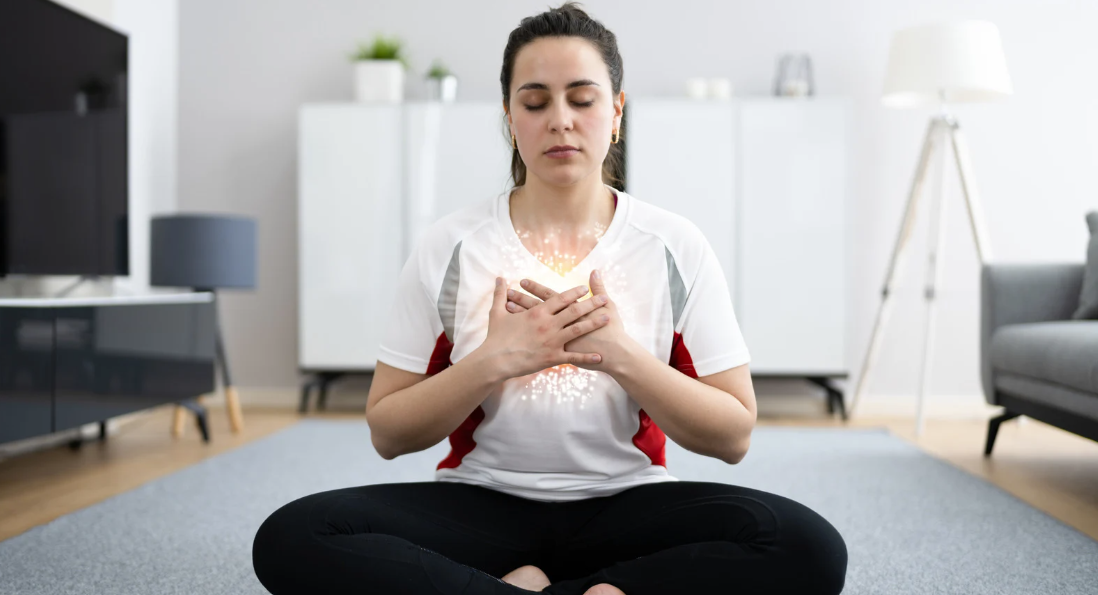
Image note: the glowing effect in the cover is illustrative, not a depiction of a measured energy field.
For another approach to reflection, see practical ways to use intuition while checking facts. If you are choosing a course, our guide to evaluating psychic-development training explains useful questions about claims and costs.
16 frequently asked questions
1. Does yoga prove that psychic abilities are real?
No. Research about wellness does not establish telepathy, clairvoyance or accurate predictions. A meaningful experience during practice is not independent verification of a psychic claim.
2. Do I need difficult poses to develop intuition?
No pose is a requirement for insight or spiritual worth. A class should not ask you to tolerate discomfort to earn an awakening, and this article does not prescribe poses.
3. How should I choose a class?
Ask about the actual activities, pace, instructor training, accessibility and options to decline or modify participation. Choose on that information rather than a promise of guaranteed powers.
4. Can I say no to hands-on adjustments?
Yes. Tell the instructor your preference before class and again if needed. Consent to attending a class is not blanket consent to physical contact.
5. What is the difference between a sensation and an interpretation?
A sensation is what you notice, such as warmth or tension. An interpretation is the meaning you give it, such as a chakra opening. Write them separately rather than treating one explanation as proven.
6. What should I record in a reflection journal?
Record the date, what happened, your interpretation, uncertainty and other possible explanations. Include quiet or uneventful sessions, not only coincidences that fit your expectations.
7. Does a vivid image mean I should act on it?
No. You can explore its personal meaning without treating it as a command, a prediction or private knowledge about somebody else. Check ordinary facts before making decisions.
8. Should I use intense breathing to seek a vision?
Do not chase dizziness or unusual sensations as proof of progress. This guide provides no rapid-breathing or breath-retention instructions; appropriate instruction and safety matter more than producing an experience.
9. What if a class dismisses pain as spiritual progress?
Step back from pressure to ignore troubling symptoms. A spiritual explanation does not establish that an activity is safe. Seek appropriate healthcare guidance rather than relying on a reading or an awakening claim.
10. Can I practice if I am pregnant or have an injury?
This article cannot assess your individual suitability. Discuss relevant conditions and any necessary modifications with your healthcare professional and a qualified instructor before choosing activities.
11. Must I accept chakra beliefs to attend yoga?
Ask how the particular class approaches philosophy and spiritual language. You can choose a setting that respects your beliefs and questions; you do not have to adopt every interpretation presented.
12. Can a psychic reader prescribe yoga for a health condition?
A reading does not qualify someone to prescribe treatment or exercise. Readers should keep spiritual discussion separate from healthcare and avoid suggesting that a practice replaces professional care.
13. Should clients be required to practice yoga before a reading?
No. Clients should not have to share a reader’s routine or beliefs to receive respectful service. Do not blame a disappointing reading on their flexibility, diet or spiritual practice.
14. How can I describe yoga in a professional reader biography?
Describe your actual routine without claiming it proves accuracy. Saying that you set aside reflective time is different from claiming that a practice guarantees predictions or verifies messages.
15. Do I need an expensive course or special equipment?
Spending money does not establish psychic ability. Before enrolling, ask what is included, what equipment is actually needed and what the cancellation terms are. Guaranteed powers and pressure to upgrade are warning signs.
16. What if yoga is not right for me?
It is optional. You can organize your workday around ordinary breaks, quiet reflection or another suitable activity without framing that choice as a spiritual failure.
‘Awakening the Third Eye’? Seriously? Sounds like something out of a fantasy novel rather than a legitimate practice. While yoga has its merits for fitness and mental clarity, attributing psychic powers to it feels more like wishful thinking than reality.
‘Visualizing your goals’ sounds great until you realize it’s just daydreaming without action! While I appreciate the effort behind this post, maybe we should focus more on tangible results rather than ethereal concepts!
“The word ‘psychic’ comes from Greek…” That’s interesting! This article does a good job of linking ancient traditions with modern practices like yoga. It’s vital for us to explore various spiritual paths while keeping an analytical perspective on their claims.
‘Modern practices’—that’s one way to put it! But let’s not forget that belief systems vary widely, and what works for one may not work for another. Respecting each individual’s journey is crucial!
I find it quite amusing how people still cling to the idea of psychic abilities despite all evidence pointing towards them being mere illusions. Yoga is beneficial for relaxation, sure, but let’s not kid ourselves about its supposed supernatural effects! 😂
This post provides a great overview of how yoga can aid in developing psychic gifts. It’s essential to approach spirituality with an open mind, and these practices can indeed enhance our connection to the universe and our own intuition.
I absolutely loved this article! The connection between yoga and psychic abilities is so fascinating. It’s amazing how meditation and mindfulness can enhance our intuitive skills. I can’t wait to start practicing these techniques! 🧘♂️✨
‘Grounding Yourself’? More like trying not to float away with all this mystical talk! This was entertaining, though I think I’ll stick to my normal yoga routine without looking for spirits or chakras! 😄
While the article presents some interesting ideas, I can’t help but feel skeptical about the claims made regarding psychic gifts. It’s hard to accept something that lacks scientific backing, and it seems a bit misleading.