


Online psychic reader ethical boundaries should be visible before a client pays and respected throughout the session. Consent, clear limits, privacy, honest claims and appropriate referrals matter more than an atmosphere of certainty.
A client may come to you for insight, comfort or spiritual connection. Clear boundaries make that experience easier to trust: the person knows what you offer, what it costs and which choices remain their own.
The CLEAR framework
CLEAR is this guide’s memory aid: Consent, Limits, Evidence, Autonomy and Referral. Privacy runs through every part. It is not an externally accredited code.
Consent
Agree on the service and ask before changing sensitive topics or methods.
Limits
Stay within your competence and the agreed time, cost and scope.
Evidence
Do not turn an interpretation into a diagnosis, accusation or guarantee.
Autonomy
Protect the client’s right to disagree, stop and choose independently.
Referral
Direct needs outside the service toward qualified, relevant help.
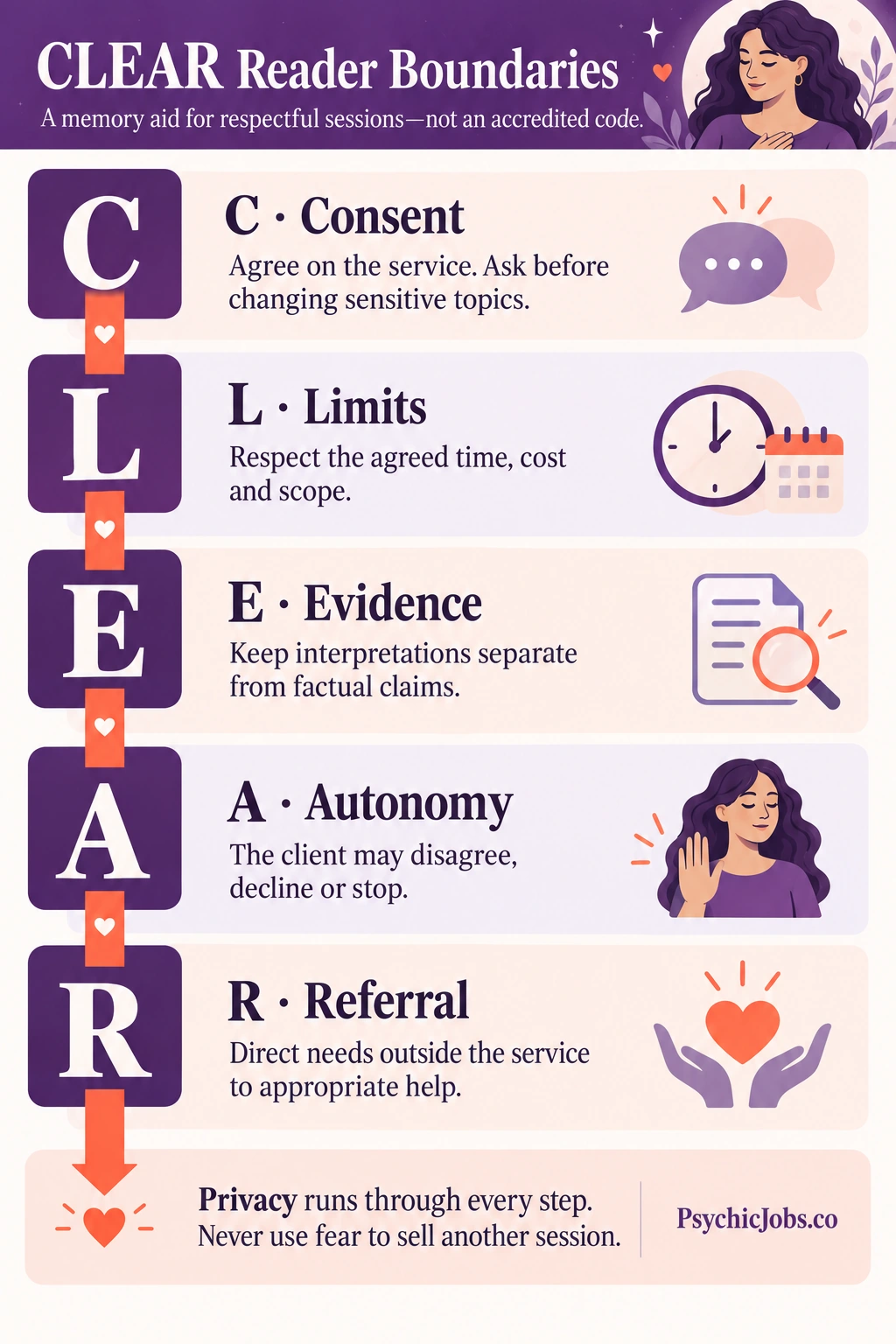
Read the infographic text
A memory aid for respectful sessions—not an accredited code.
- C · Consent: Agree on the service. Ask before changing sensitive topics.
- L · Limits: Respect the agreed time, cost and scope.
- E · Evidence: Keep interpretations separate from factual claims.
- A · Autonomy: The client may disagree, decline or stop.
- R · Referral: Direct needs outside the service to appropriate help.
Privacy runs through every step. Never use fear to sell another session.
Consent is specific and ongoing
Booking a relationship reading does not authorize unexpected sexual commentary, pregnancy claims or accusations about a partner. Explain the topic, format, duration, total or per-minute rate, follow-up limits and cancellation terms before beginning.
Ask separately about recording, storing notes and using testimonials. A client can accept the service while refusing publicity. Silence after an upsetting statement is a reason to pause and check in, not proof that the message is spiritually important.
A short opening can help: “We have agreed to this topic and time limit. These are interpretations, not guaranteed facts. You can decline a question or ask to stop. Shall we begin?” Use wording consistent with your actual policies.
For the additional sensitivities of bereavement sessions, see mediumship etiquette, consent and boundaries.
Keep impressions, interpretations and facts separate
“I picture a locked door” describes an impression. “It could symbolize hesitation” offers an interpretation. “Your employer has decided to fire you” claims a fact. The third statement requires evidence that an impression does not provide.
Do not diagnose illness, identify supposed criminals, declare someone dangerous from a reading or promise investment outcomes. You can help a client formulate questions for a qualified professional without supplying the professional answer yourself.
A disclaimer does not make a contradictory cure claim responsible. The FTC’s health-products advertising guidance discusses truthful, non-misleading claims and scientific substantiation. It is relevant background when marketing health-related products; it is not a substitute for advice about your own service or jurisdiction.
The distinction also applies to tools: see divination methods and their limits and tarot reversals without ominous guarantees for examples of responsible framing.
Do not create dependence through urgency
A reader should not claim that a client’s safety, relationship or luck depends on another purchase. Do not manufacture an emergency and then offer yourself as the only paid solution.
Set clear follow-up limits and avoid unsolicited predictions designed to bring clients back. If someone repeatedly asks the same question for reassurance, ask what has changed and whether more readings are helping. Declining another paid session can be the more responsible choice.
Respect a cancellation or disagreement without calling it spiritual resistance. Clients should be free to consult others and leave without threats about curses, blockages or unfinished rituals.
Privacy requires an actual process
Explain what you collect, why, who can access it, how long it is retained and how clients can make privacy requests. Do not promise deletion that your platform or recordkeeping obligations cannot support.
The NIST Privacy Framework is a voluntary organizational tool for identifying and managing privacy risk. A small practice can use the general risk-management approach without claiming NIST certification or automatic legal compliance.
- Collect only information genuinely needed for the service.
- Protect accounts with strong authentication and restrict access.
- Keep recordings, notes and intake forms only under a justified retention policy.
- Never publish screenshots or client stories without appropriate permission.
- Remember that removing a name may not anonymize distinctive details.
Avoid building sensitive dossiers about people who are not clients. Someone asking about a partner does not authorize inventing or circulating claims about that partner’s medical history or private behavior.
Prepare for crises before they arise
Have a written process for immediate danger, self-harm concerns, abuse, stalking and medical emergencies. Do not attempt to resolve a crisis with tarot, visions or a paid energy service. Encourage appropriate local emergency or crisis help when immediate safety is at risk.
Know your platform’s escalation route and seek qualified guidance about any reporting obligations. Do not promise absolute confidentiality when legal or platform exceptions may apply. Explain relevant limits clearly before sessions.
Also establish policies for age eligibility, harassment, sexual requests, billing disputes and attempts to obtain another person’s private information. Readers have the right to end abusive interactions.
Make complaints possible
Provide a contact route that does not require a client to argue with the reader. State the response process, possible remedies and how a concern can be escalated. Where feasible, arrange review by someone not directly involved in the disputed session.
Subjective interpretation is not an excuse for unauthorized charges, threats or privacy misuse. Review patterns of complaints and apply the same conduct expectations to popular readers and newcomers.
Peer consultation can help with difficult situations, but protect client confidentiality and do not present it as clinical supervision unless it genuinely is. Training in consent, privacy and scope is as important as learning a reading technique.
Key Takeaways
- Consent to a service is not consent to every topic or use of personal data.
- Interpretations should never masquerade as high-stakes facts.
- Ethical boundaries protect clients’ freedom to stop and disagree.
- Crisis needs belong with appropriate support, not an upsell.
- Written policies matter only when followed.
15 frequently asked questions
1. What does CLEAR mean?
Consent, Limits, Evidence, Autonomy and Referral. It is an editorial memory aid in this guide, not a formal accreditation.
2. What should be agreed before an online reading?
The topic, method, duration, price, follow-up limits, cancellation rules and how the client can stop.
3. Can a reader introduce sensitive topics without asking?
Do not assume a general booking covers sexual, pregnancy, trauma or other sensitive discussion. Check consent before changing scope.
4. Is a client’s silence agreement?
Silence or distress should not be treated as consent. Pause and ask whether the client wants to continue.
5. Can a psychic diagnose a health condition?
A reading should not be used to diagnose or prescribe. Direct health concerns to an appropriately qualified professional.
6. Does an entertainment disclaimer excuse misleading claims?
No. A disclaimer should not contradict the service’s actual claims or be used to justify irresponsible guarantees.
7. Can a reader publish chat screenshots?
Not without appropriate permission and privacy safeguards. Removing a name may still leave a client identifiable.
8. Should every session be recorded?
No. Explain the purpose and policy, obtain appropriate consent and consider whether recording is necessary at all.
9. How long should client notes be retained?
Use a justified retention policy consistent with applicable obligations and platform rules. There is no universal period supplied by this guide.
10. What if a client repeatedly seeks reassurance?
Consider pausing repeat sessions and discussing whether readings are helping. Do not use distress to sell more time.
11. How should a reader respond to immediate danger?
Follow a prepared escalation process and encourage appropriate local emergency or crisis support. Do not attempt a psychic solution.
12. Can a reader refuse an abusive client?
Yes. Set conduct rules and end harassment or threatening interactions through the platform’s appropriate procedures.
13. Can a client request facts about a partner’s private life?
A request does not make unverified claims factual or remove third-party privacy concerns. Keep the discussion within responsible limits.
14. Why offer a separate complaint route?
It lets clients raise concerns without confronting the reader directly and supports fair review of conduct and billing issues.
15. Where should I put my service boundaries?
Put the main limits, price and stopping procedure in your profile or booking information, repeat them briefly before the session and make the full policies easy to find.