


Phone psychics can reduce their risk of burnout by managing their workload, taking breaks, and keeping clear boundaries. A calming ritual can be helpful, but it doesn’t mean that you won’t have an exhausting schedule or a business model that makes every pause feel unaffordable.
Doing a phone reading means that you have to listen. Clients might talk about grief, uncertainty, and conflict, and ask questions that feel urgent. A reader who looks at this work with care can still get tired or overwhelmed. If you experience stress, it doesn’t mean that you’ve lost your intuitive gift or you’ve picked up negative energy.
Occupational-health guidance can offer useful starting points for managing workload and recovery. A phone psychic has a different role from a clinician or crisis counselor, so focus on the actual demands of your work and seek qualified support when needed.
If you understand your practice spiritually, then you know that ordinary care can fit along with that prospectively. Sleep, having reasonable hours, and getting confidential support and time away from clients are all good ways to be thoughtful of your own well-being. You don’t have to choose between your beliefs and your health.
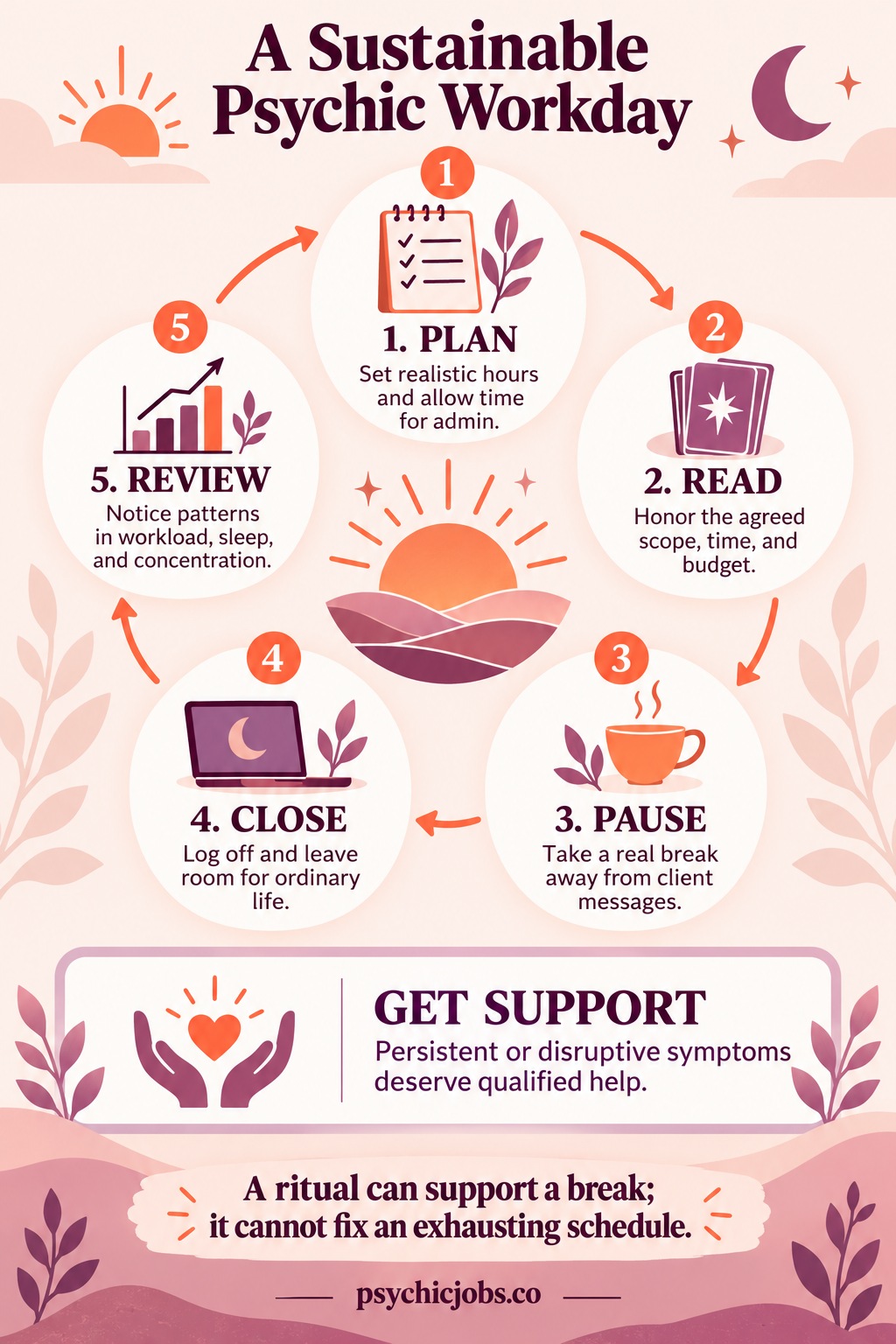
Read the infographic as text
- 1. PLAN: Set realistic hours and allow time for admin.
- 2. READ: Honor the agreed scope, time, and budget.
- 3. PAUSE: Take a real break away from client messages.
- 4. CLOSE: Log off and leave room for ordinary life.
- 5. REVIEW: Notice patterns in workload, sleep, and concentration.
- GET SUPPORT: Persistent or disruptive symptoms deserve qualified help.
A ritual can support a break; it cannot fix an exhausting schedule.
Understanding Terms
World Health Organization's burnout explanation describes burnout as an occupational phenomenon linked to chronic workplace stress that has not been successfully managed. Its description includes exhaustion, distance or cynicism toward work, and reduced professional effectiveness. It is not classified there as a medical condition.
Compassion fatigue is used in helping-work discussions to describe strain associated with caring for people in distress. SAMHSA’s resources for crisis counselors connect it with burnout and secondary traumatic stress. Those materials concern crisis counselors, and phone psychics have a different role and should not think that every tiring call produces the same process.
Having a hard afternoon doesn’t mean that you should diagnose yourself. Tiredness can relate to poor sleep, sickness, medication, stress, or other things. If the symptoms persist or they affect your daily life, talk to a qualified healthcare professional.
Use the terms to help guide your attention instead of assigning an identity. Ask what’s making this hard to sustain, and this can lead to useful changes instead of asking if you’re spiritually damaged.
Pay Attention When Your Routine Starts to Feel Different
Notice when giving readings starts to feel different from what’s normal for you. You might have a harder time staying focused on a client’s question, feel more tired than usual, or notice that you’re not looking forward to logging in. You might start rushing through the end of readings or stay online much longer than you planned because you don’t want to disappoint a client.
These changes can be signs that it’s time to look at your schedule and give yourself a little more breathing room. Even experienced readers can become tired after several readings in a row, especially when clients are discussing emotional or complicated situations. Taking care of your own energy can also help you stay present and focused during each reading.
It can help to keep a short private note about how you felt during the workday without writing down personal details about your clients. For example, you might write, “After my third reading in a row, it was harder to concentrate. I also skipped lunch and hadn’t taken a break from my desk.” Looking back at notes like these can make it easier to notice patterns and decide what might need to change.
Strong feelings during a reading can also be worth noticing. Readers sometimes experience emotions, physical sensations, or shifts in energy as part of the way their psychic gifts work. At the same time, being tired, hungry, stressed, or emotionally drained can affect how you feel too. Giving yourself time to reset can make it easier to tell the difference and return to your readings feeling more focused.
Creating a Schedule That Gives You Time to Recharge
Decide how long you want to work before you log in and have a general stopping point in mind. Remember to leave room for things that happen outside the actual reading, including preparing, answering messages, updating your schedule, and taking time to recharge afterward.
There isn’t one number of readings that work for every psychic reader. One person might feel comfortable doing several shorter readings in a day, while another might need more time between longer or emotionally intense readings. Start with a schedule that feels manageable and pay attention to how you feel as you use it.
You can also leave a short amount of time between readings and take a longer break after several clients. Use that time to get something to eat, stretch, step outside, journal, meditate, work with a crystal, or just get away from the screen for a while. Even a little space between clients can help one reading end before the next one begins.
If a reading starts going beyond the amount of time you and the client planned, give them a gentle reminder. You might say, “We’re getting close to the time we planned, so let’s go over the main things that came through and any final question you have before we finish.” This gives the reading a natural ending while also respecting the client’s time and budget.
Having boundaries around your schedule doesn’t make you less dedicated to your clients. It can help you protect your energy, give each client your attention, and continue doing readings in a way that feels meaningful instead of exhausting.
Taking Breaks
A break spent answering client messages is still working. A break spent looking at a difficult review call can still keep your attention tied to the reading. If you can step away from the screen, go to a new area and let your attention go to a regular activity.
Pick something easy enough to do on a consistent basis. Fix yourself a drink, go outside for a walk, or stretch in a way that’s comfortable to you. You don’t have to do a hard routine or make a purchase to take a pause.
If you like a closing ritual, keep it simple. You might put away the deck of cards or say a short sentence to mark the end of your work block. Know that the ritual is a personal transition. Don’t decide that a missed ritual means that you’re unable to rest safely.
Check if the break helps in your practice. If you go back to work feeling just as overloaded, then think about if the workload needs to change. Having a bunch of tiny pauses doesn’t always repair too many hours of intense listening or a schedule that leaves room for regular life.
Make Your Breaks Feel Like Real Breaks
A break spent answering client messages is still part of the workday. The same can happen if you spend the entire break thinking about the reading you just finished. When possible, step away from the screen, change your surroundings for a few minutes, and give your attention to something completely different.
Pick something easy that you can actually do throughout the day. Get a drink, look outside, take a short walk, stretch, have a snack, or just sit somewhere away from your reading space for a few minutes. You don’t need an elaborate routine or anything expensive to give yourself time to recharge.
If you enjoy having a closing ritual after readings, that can become part of your routine too. You might put your tarot or oracle deck away, cleanse your reading space, work with a crystal, say a prayer, or use a short phrase that marks the end of that reading or work period. A familiar ritual can help you shift your attention away from the reading and back into the rest of your day.
Pay attention to how you feel when you return. If a few minutes away helps you feel refreshed and ready for another client, the break is probably doing what you need it to do. If you still feel completely drained after every break, you might need more time between readings or fewer readings packed into the same day. Short breaks can help, but they can’t always make up for a schedule that has become too exhausting.
Care About Clients Without Carrying Everything Home
Caring about your clients can be an important part of giving meaningful readings, especially when someone comes to you during an emotional or difficult time. At the same time, you don’t have to carry responsibility for every decision another person makes after the reading.
A client might really want a partner to come back, a particular job to work out, or a family situation to change. You can give the reading, share what comes through, and help the client explore the situation without feeling like you personally have to make the outcome happen.
The way you explain this can still feel supportive. You might say, “We can look at the energy around the situation and what comes through during the reading, but the other person still has their own choices to make.” This leaves room for the psychic reading while also recognizing that everyone involved has free will.
After an emotional reading, think about what really fits in your role. Giving the client your attention, sharing the messages or impressions that came through, answering appropriate questions, and treating them with compassion are all things you can do. You don’t have to solve every part of their situation for the reading to have value.
For example, a reader might still be thinking about a client after hearing about a painful breakup. It’s natural for some readings to stay on your mind for a while. That doesn’t mean you need to stay available through private messages all night to prove that you care. Having limits on when you’re available can protect your personal time while still allowing you to care about what the client is going through.
Know What to Do When a Reading Goes Beyond Your Role
Learn the platform’s rules for situations involving immediate danger, self-harm, abuse, medical concerns, and other serious situations before you encounter one during a reading. Knowing what steps to follow ahead of time can make it easier to respond when a client brings up something that needs a different kind of support.
If someone describes an immediate safety emergency, direct them toward appropriate emergency or crisis support and follow the platform’s procedures. A spiritual reading can still be meaningful to someone going through a difficult time, but an emergency also needs the kind of immediate help that’s appropriate for the situation.
It can help to have a few easy boundary phrases ready too. You might say, “That symptom needs to be discussed with a medical professional,” or “That legal deadline is something you’ll want to confirm with a qualified professional.” For financial questions, you might explain that the reading can explore the situation spiritually while investment decisions need appropriate financial guidance.
Referring someone to another type of help doesn’t mean that you don’t care about them or that the reading wasn’t valuable. Different situations call for different kinds of support. Knowing where your role ends can help you continue offering the spiritual guidance, you’re there to provide without feeling responsible for doing every job a client might need.
Don’t Let Every Rating Control the Reading
Ratings and reviews can create a lot of pressure, especially when your income depends on clients wanting to come back. It can become tempting to keep a reading going longer than planned, avoid saying something a client might not want to hear, or feel like every person has to leave completely happy.
Instead, focus on the things you can control. Give clients your attention, explain the reading clearly, treat them respectfully, be upfront about prices and time, and stay consistent with the type of reading you offer. A client can still feel disappointed if the answer isn’t what they hoped to hear, and that doesn’t automatically mean that the reading was handled poorly.
If you receive a complaint, follow the platform’s process and give yourself time to look at what really happened. Try not to spend the rest of the night repeatedly checking ratings or reviews. If you’re allowed to respond publicly, keep the response professional and protect the client’s privacy instead of sharing personal details from their reading.
If you work with other readers, difficult situations can also become useful learning opportunities without identifying the client. A discussion might focus on something like, “What are some good ways to respond when a client wants an exact date?” This gives everyone a chance to share ideas without turning someone’s private reading into a story being passed around.
Make Your Income Part of the Plan
When income changes from week to week, it can be harder to give yourself permission to log off. A slow day might make you want to stay available for hours, and a difficult month might make it harder to turn down a reading that goes beyond what you normally offer. That’s why the financial side of psychic work needs to be part of the plan too.
Look at how much you’re earning compared with the total amount of time you’re spending on the work. Include time spent waiting for calls, answering messages, updating your profile, handling scheduling, and doing other tasks outside the actual readings. A per-minute rate can look good at first, but the full picture becomes clearer when you look at the entire workday.
Try not to respond to a slow month by offering clients unlimited access or more time than you can realistically provide. Clearly defined readings, response times, prices, and availability can make things easier for both you and your clients. Clients know what they’re paying for, and you have a clearer idea of how much time each service requires.
If you manage other psychic readers, pay attention to the way payment and incentives affect their schedules too. Readers shouldn’t be encouraged to protect their boundaries while also feeling pressured to keep every call going as long as possible. A healthier system gives readers room to provide meaningful readings while still protecting their time, energy, and income.
Building Support
Pick someone that you can trust to talk about the demands of your work, such as a supervisor, a trusted peer, or a qualified professional. Agree on confidentiality and don’t share client details. Support should help you to reflect on your own responses and working conditions.
You might do good with benefit from relationships that aren’t related to your psychic work. Having ordinary conversations, shared activities, and time with people that know you outside of your psychic work can make it easier to step away from client concerns when needed.
NIMH's mental-health self-care guidance supports attention to everyday well-being and seeking professional help when difficulties become significant. It does not provide a psychic-specific treatment plan. Use it as general health information alongside individualized support when needed.
If you have a hard time sleeping, you’re constantly thinking about calls, or you’re having a hard time functioning outside of work, take this seriously. You don’t have to wait until you can say the problem before you contact a healthcare professional.
A Weekly Review
At the end of your work week, look at the questions you have.
- Which call blocks felt manageable?
- When did you skip breaks?
- Did you respect your planned time?
- Did administrative work spill into your evening?
Use the answers to make changes that you can keep. If someone comes to get a reading and the reader realizes that late-night calls leave them little time to wind down, instead of adding a longer cleansing ritual after midnight, move the last work block earlier and don’t accept calls before the end of the shift. This could be a good closing routine that fits into your schedule and allows you recovery time.
Another reader might find that the hardest demand isn’t the length of the call, but the request for private follow-up. A good change is to create a clear response policy. Make sure you’re identifying the pressure instead of applying the same routine to each problem.
Write down what changes after you make the adjustment. If your concentration improves and the evenings feel more available, keep the habit. If you’re still stressed, look at the workload, get support, or consider taking time away. Recovery is a good process and not a test of how spiritually disciplined you really are.
Protecting the Space
A good psychic phone practice makes space for care without there being unlimited availability. Psychic readers can give warmth, interpretation, and clear boundaries, and still stay grounded with health needs and forever attention.
Start with hours that are manageable, take real breaks, and set a referral program. Make sure that the support respects confidentiality. Look at the conditions when you get tired. These help keep spiritual work connected to the rest of life instead of letting the reading role consume you.
Final Thoughts: Between the Calls
Prepare the listing, take care of billing questions, and reading policy updates. All this takes time, and if you schedule these tasks after your final call, the working day might go beyond the hours you intended to put in. Always put a realistic administrative block into the plan and see if it fits your needs.
Separate client-facing availability from the total time you have to devote to the business. This allows you to look at the workload more accurately and explain the response window to clients. A reader can still stay committed while needing time that is available for new readings.
If administration repeatedly exceeds the planned time, look at the calls. Maybe the service description needs to be clear, a platform tool is hard to use, or the policy causes unnecessary messages. Improving the process can get rid of strain and help you to work faster and more efficiently.