


Becoming a psychic medium isn’t always understood because it’s not just about being intuitive. It’s about developing your awareness, learning to interpret subtle signs, and working with spiritual communication.
Mediumship is a type of psychic gift. There is an intuition that relates to sensing situations and people, but mediumship focuses on connecting with impressions or energies that go beyond your own thoughts.
For most people, this isn’t something that happens fast, but it develops slowly through practice, awareness, and learning to stay grounded while having more perception.
What is a Psychic Medium?
A psychic medium is someone who can pick up and interpret communication beyond the physical senses. This can show up in different ways depending on the medium.
While some mediums have visual impressions or mental imagery, others pick up internal sound, strong intuitive knowing, or emotional impressions that are separate from their own thoughts or feelings. These are often grouped into different types, such as:
- Clairvoyance: Visual impressions or imagery.
- Clairaudience: Hearing internal messages or subtle messages.
- Clairsentience: Picking up emotions, energies, or just knowing information without logic.
The style depends on the person, and developing mediumship means recognizing which kind of perception feels most natural to you and strengthening it as time goes on.
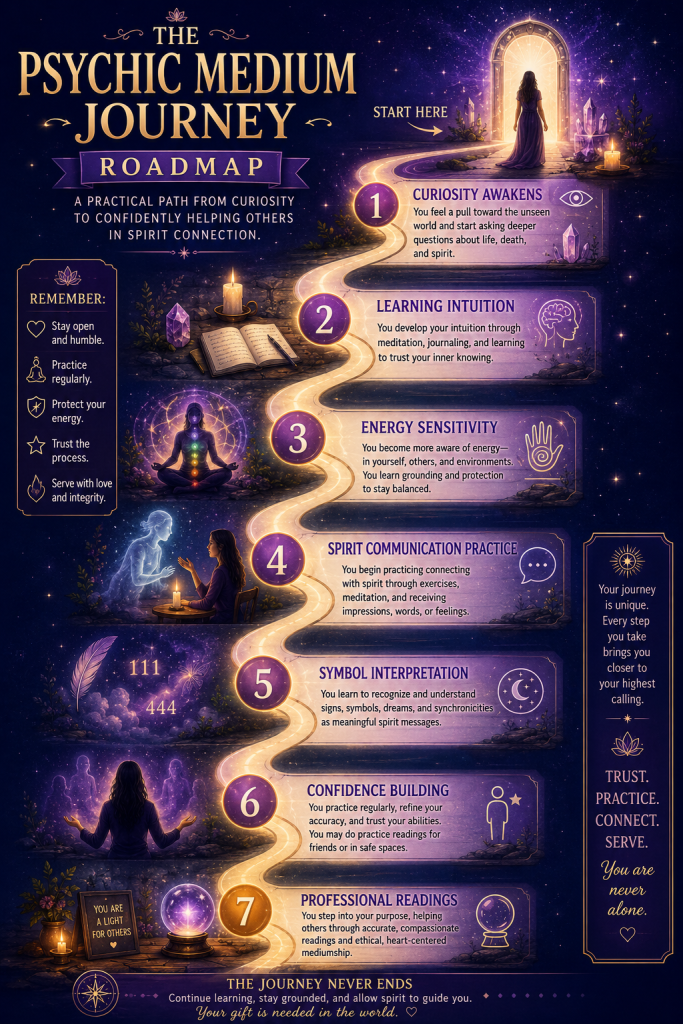
Recognizing Your Natural Awareness
Before developing mediumship or intuitive abilities, it helps to understand your natural level of sensitivity.
Some people notice intuitive feelings early in life, such as strong gut instincts, vivid dreams, or emotional awareness. Others may not have obvious experiences but still feel naturally drawn toward spirituality or intuition. It can help you to ask yourself questions like:
• Do you easily pick up on other people’s emotions?
• Do you sometimes know things without clear reasoning?
• Have you experienced moments that felt difficult to explain logically?
Even subtle awareness can become stronger over time. The important part is noticing these experiences instead of immediately dismissing them.
It’s also important to stay balanced and realistic. Not every experience has a spiritual meaning, and staying grounded helps keep the process healthy.
Building Awareness First
Developing mediumship starts with awareness before anything else.
Creating quiet moments during the day allows you to pay more attention to your thoughts, emotions, and subtle impressions without constant distraction. As awareness grows, you may begin noticing things like:
• Thoughts that appear suddenly and feel different from normal thinking.
• Emotional shifts that don’t seem connected to your surroundings.
• Subtle impressions that are easy to overlook at first.
The goal isn’t to force communication or dramatic experiences. It’s about becoming more aware of what you naturally notice already.
Strengthening Intuitive Skills
Before focusing deeply on mediumship, it helps to strengthen general intuitive abilities.
Practices like journaling, meditation, and object-reading exercises can help train your mind to notice patterns and impressions more clearly. Helpful exercises can include things like:
• Writing down intuitive thoughts and dreams.
• Meditation to quiet mental distractions.
• Holding objects and observing first impressions.
These practices help build a stronger foundation for intuitive awareness over time.
Exploring Communication Practices
Some people choose to explore more structured ways of practicing mediumship or intuitive communication.
This often involves creating a quiet environment, setting an intention, and staying calm and observant during the process.
Impressions may appear as things like:
• Words or short phrases.
• Images or symbols.
• Emotional feelings or physical sensations.
Early impressions are not always clear, so it’s important to stay patient and avoid forcing meaning too quickly.
Staying Grounded and Balanced
One of the most important parts of intuitive development is staying grounded emotionally and mentally.
Without balance, it becomes easier to feel overwhelmed or confused by experiences and emotions. Easy grounding practices can include things like:
• Focusing on slow breathing.
• Spending time outside or in nature.
• Stretching, walking, or reconnecting physically with your surroundings.
Healthy boundaries also matter. Not every feeling or impression needs deep interpretation.
Learning From Different Perspectives
Reading about other psychics, mediums, and intuitive experiences can help create a more realistic understanding of the process. You may notice similarities in:
• How intuitive impressions appear.
• How awareness develops gradually over time.
• The importance of patience and practice.
At the same time, it’s helpful to stay thoughtful and avoid believing every claim automatically. Learning from different perspectives creates a more balanced view.
Practicing With Real Situations
As confidence grows, some people choose to practice intuitive skills with trusted friends or family members. This might involve things like:
• Sharing intuitive impressions.
• Observing emotional reactions or energy shifts.
• Practicing communication respectfully and carefully.
It’s important to focus on your own impressions rather than relying on hints or leading questions.
This helps strengthen confidence and clarity over time.
Understanding the Responsibility
Working with intuition or mediumship also comes with responsibility, especially when other people are emotionally vulnerable. It’s important to:
• Avoid making absolute claims.
• Be honest about uncertainty.
• Focus on supportive and respectful communication.
Developing awareness is important, but emotional responsibility matters just as much.
Learning in Structured Settings
Some people choose to learn through workshops, classes, or group practice. This can give you things like:
• Guidance from experienced practitioners.
• A more structured learning environment.
• Helpful feedback and support.
While this isn’t necessary for everyone, structured learning can help create more confidence and direction.
Allowing Growth Over Time
Mediumship and intuition usually develop slowly rather than all at once. As you continue practicing, you may begin noticing things like:
• Stronger awareness of subtle impressions.
• More confidence in your interpretations.
• Better focus and emotional balance.
The process can be slow and gradual, and patience is often one of the most important parts of growth.
Final Thoughts: Being a Psychic Medium
Being a psychic medium isn’t about unlocking something that you have hidden, but it’s about being disciplined, aware, and balanced as time goes on. There are some people who have strong gifts, while others need to develop them. Both of the outcomes can be amazing.
The most important part of this is to stay open, curious, and grounded without forcing the process or losing sight of what you’re meant to do.
FAQ
1. What is a psychic medium?
A psychic medium is someone who believes they can receive intuitive impressions connected to spirit communication, energy, emotions, or symbolic messages.
2. How is a psychic medium different from a psychic?
A psychic usually focuses on intuitive insight about life, emotions, relationships, and possible paths, while a medium focuses more on spirit communication.
3. Can anyone become a psychic medium?
Many people believe mediumship can be developed with practice, patience, emotional balance, meditation, and consistent intuitive training.
4. Do you have to be born with mediumship abilities?
Some people feel naturally sensitive from a young age, but many beginners develop stronger awareness through study, practice, and spiritual discipline.
5. How do I start developing mediumship?
Start with meditation, journaling, grounding, dream tracking, energy awareness, and simple exercises that help you recognize subtle impressions.
6. What are signs you may have mediumship ability?
Common signs may include strong intuition, vivid dreams, emotional sensitivity, feeling energy shifts, noticing symbols, or sensing presences.
7. Is mediumship the same as intuition?
No. Intuition is usually the foundation, while mediumship is a more specific practice focused on receiving messages connected to spirit energy.
8. How long does it take to become a psychic medium?
There is no fixed timeline. Some people notice progress quickly, while others need months or years of practice to feel confident and consistent.
9. What exercises help develop mediumship?
Helpful exercises include meditation, sitting in silence, symbol journaling, dream recall, energy reading, grounding, and practicing intuitive impressions.
10. Why is grounding important for mediums?
Grounding helps you stay calm, emotionally balanced, and connected to the present moment while exploring spiritual or intuitive experiences.
11. Do psychic mediums need protection practices?
Many mediums use protection practices such as visualization, prayer, boundaries, meditation, or energy clearing to feel safe and centered.
12. Can you practice mediumship online?
Yes. Many beginners practice through online classes, virtual circles, video sessions, spiritual communities, and remote intuitive exercises.
13. What tools do beginner mediums use?
Common tools include journals, tarot cards, oracle cards, candles, crystals, meditation music, pendulums, and dream notebooks.
14. Do psychic mediums always receive clear messages?
No. Messages may feel symbolic, subtle, emotional, visual, or incomplete. Developing clarity usually takes practice and patience.
15. How can I tell if a message is real or imagination?
Many practitioners look for calm, consistent, meaningful impressions rather than forced, dramatic, or emotionally reactive thoughts.
16. Is it necessary to join a mediumship circle?
No, but a supportive practice circle can help beginners build confidence, receive feedback, and learn from others in a structured setting.
17. Can mediumship become a career?
Yes. Some people offer private readings, online sessions, spiritual coaching, teaching, group events, or content creation after gaining experience.
18. What makes an ethical psychic medium?
An ethical medium communicates with compassion, avoids fear-based claims, respects boundaries, does not pressure clients, and stays honest about uncertainty.
19. Should beginners charge for mediumship readings?
Beginners usually benefit from practicing first, gathering feedback, and building confidence before offering paid readings professionally.
20. What is the best first step to becoming a psychic medium?
The best first step is to build a calm daily practice with meditation, grounding, journaling, and careful observation of intuitive impressions.
Nice read, uplifting and calm. It makes the whole idea of mediumship less mystifying and more like a craft you can learn over time. I liked the tips about grounding and protection practices, and the encouragement to seek structured learning if you want extra feedback. 🌟
Well-structured and considerate. I appreciated the clear distinctions between intuition and mediumship and the emphasis on measured practice, patience, and ethics. The guidance about journaling impressions, testing accuracy, and prioritizing client welfare resonated strongly as responsible, compassionate direction for learners.
This is an insightful synthesis that balances encouragement with healthy skepticism, which I appreciate. The nuanced attention to different perception modalities—visual, auditory, emotional—helps demystify mediumship without reducing it to either mere psychology or unfettered mysticism. The sections on ethical responsibility and grounding are particularly commendable.
Sincere, practical guidance. I find the emphasis on cultivating awareness through daily quiet moments particularly valuable, because discipline often matters more than dramatic experiences. The piece gives concrete practices, like dream journaling and walking in nature, that feel accessible and genuinely supportive for steady development. 🌿
Clear, balanced guide. The breakdown between intuition and mediumship helped me see the difference, and the exercises like object-reading and meditation sound manageable. I especially liked the reminders about ethics, boundaries, and not making absolute claims. This feels thoughtful and useful for beginners.
I like how this explains that mediumship takes time and practice. It feels less scary when you hear that grounding, journaling, and simple exercises are helpful. The list of signs and beginner steps makes me feel calm and eager to try small practices. Thank you 😊
Great overview that keeps things practical. I appreciate the emphasis on awareness and not forcing experiences. The advice about staying grounded and checking impressions feels respectful and safe. I also like the FAQ because it gives realistic expectations for new learners, very encouraging.
Helpful, grounded writing. The recommended exercises feel like a reasonable place to begin, such as object-reading and quiet meditation, and I like that growth is framed as gradual. Reminders to practice with trusted friends and to avoid leading questions are practical and kind guidance for newcomers.